
Rugby's global calendar has never been this packed: the autumn internationals are running now across Europe, the Six Nations returns in February 2027, and the Rugby World Cup lands in Australia in 2027 — while women's rugby keeps setting participation records in the United Kingdom, Ireland, France, the USA and Australia. Below all of it sits the club game, and every club needs kit that survives a sport played without pads. This guide covers everything club committees, coaches and program directors need to know about custom rugby jerseys and full club kits: how rugby jerseys are actually built, fabrics and collars, the rules that shape numbering and sponsor placement, hoops versus modern sublimated design, women's and girls' cuts, real 2026/27 pricing and the ordering windows that matter — written by the team that cuts and sews custom rugby kits on three continents.
01Rugby's global moment — and why kit demand follows it
Between the autumn internationals running this month and a home Rugby World Cup in Australia in 2027, the sport's buying cycle is compressed and intense — and clubs order ahead of the wave.
- The autumn internationals (November 2026) are filling stadiums across Britain, Ireland, France and Italy right now — the yearly reminder, at every club's AGM season, what the top of the game looks like.
- The Six Nations (February–March 2027) is the largest annual tournament in European sport by attendance; club registration for the following season peaks while it runs.
- Rugby World Cup 2027 in Australia lands with the whole Southern Hemisphere club system in its slipstream — Australian club seasons order months ahead of September kickoff.
- Women's and girls' rugby is the fastest-growing team-sport category in the UK and Ireland, with dedicated squad kit budgets appearing at clubs that never carried women's sections five years ago.
02What a full custom rugby kit includes
A rugby kit is a system — jersey, shorts, socks and training layers that all carry the club identity:
- Rugby jersey — heavyweight sublimated or hooped jersey with reinforced construction; the club's primary identifier on every pitch it plays on.
- Rugby shorts — built with reinforced waistbands, internal drawcords and seams rated for rucking; usually white or club colours.
- Rugby socks — hooped or solid, matched to the jersey design; squad orders include two pairs per player as standard practice.
- Training kit — rugby polos for coaches and sidelines, plus hoodies and tracksuits for winter sessions and tours.
- Sevens variations — lighter, tighter-fitting jerseys for sevens tournaments, where the game's pace replaces the contact load.
See the SPORTIFY rugby collection for the full range, and the team packages page for how full-club outfitting is bundled and priced.
03How rugby jerseys are built differently
Rugby is the only major team sport played without pads — the jersey itself absorbs the physical game, and its construction shows it.
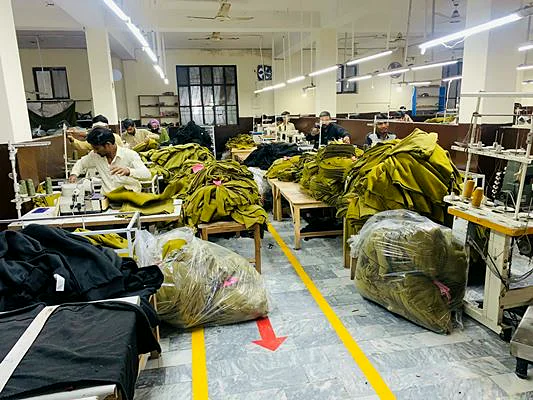
- Heavyweight fabric — 200–260 GSM polyester interlock or poly-cotton blends, roughly double the weight of a soccer jersey; the garment must survive a season of mauls and one-on-one tackling.
- Reinforced shoulder and side seams — the load paths when a player is grabbed and driven; bar-tacked stitching at every stress point is the difference between a one-season and three-season jersey.
- The collar tradition — the rugby collar exists for grip in the tackle and heritage on the crest side; traditional full collars, modern half-collars and crew necks are all standard options.
- Stretch panels — poly-spandex side panels so the jersey stretches with the tackler's pull instead of tearing at the seam.
- Optional chest grip print — textured silicone-style zones for ball carriers; increasingly requested by sevens and backs-line players.
04Rules and traditions that shape rugby jersey design
Rugby has the strongest numbering tradition of any team sport, and unions regulate the commercial zones:
- Position numbering 1–15 — in fifteen-a-side tradition the starting jersey numbers map to positions: 1–3 the front row, 9 the scrum-half, 10 the fly-half, 15 the fullback. Clubs follow the tradition for first-team jerseys; squads that rotate heavily often switch to squad numbers.
- Back numbers, small front numbers — a large number on the back and a small number on the front-left chest are the standard layout; surnames above the back number are optional.
- Union sponsor regulations — sponsor logo sizes and placements are regulated differently by each union for competitive matches; clubs in league competition should send their union's or league's branding rules with the logo set.
- Crest on the left chest — the club crest sits over the heart by tradition; the right chest and center-front carry sponsor or competition badges.
05Design directions: hoops, heritage and modern sublimation
Rugby design lives between two poles — and the strongest club identities deliberately hold both:
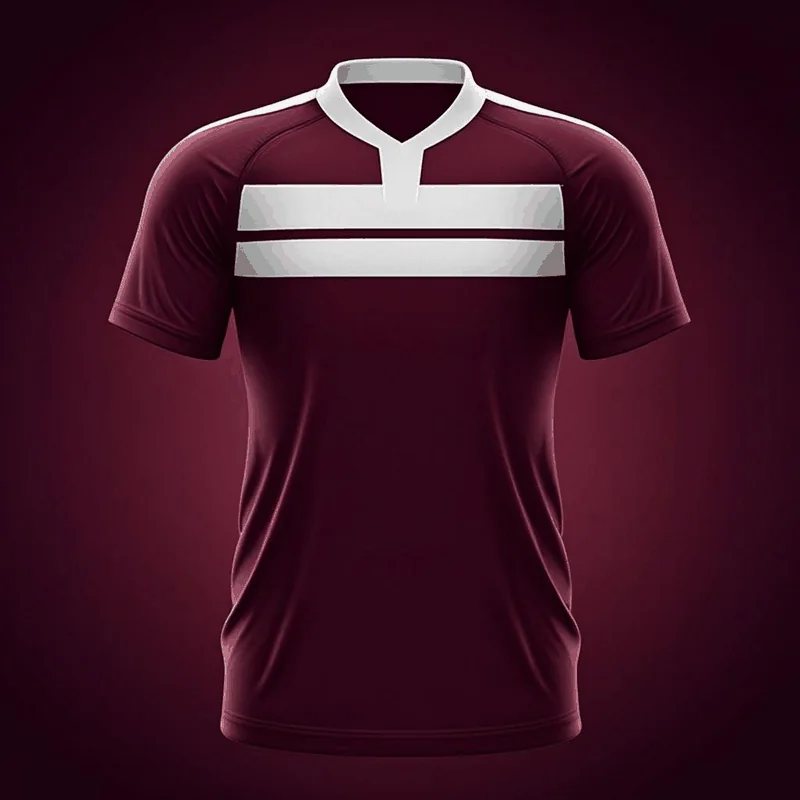
- Traditional hoops — two or three horizontal colour bands, the visual signature of the sport's heritage clubs; instantly recognisable from any stand.
- Modern gradient sublimation — league-influenced fades and aggressive graphics, dominant in sevens and the Southern Hemisphere club game.
- Hybrid designs — hoops with a subtle gradient edge or graphic fill; the compromise clubs choose when tradition and modernity both have votes on the committee.
- Poly-cotton heritage feel — a slightly matte, cotton-hand fabric with sublimated design; looks like a classic jersey, performs like modern kit.
- Away and alternate kits — reversed or simplified versions of the primary design for colour clashes; sublimation makes alternate kits cheap to include in the same run.
Factory Tip — The Committee-Proof Design Process
- Bring two directions to the club committee — one heritage, one modern — and let the free mockup stage settle the debate visually instead of in the meeting.
- Approve the away kit in the same mockup round as the primary; adding it later restarts setup and delays the whole run.
- Ask for a grayscale version of the design — if the hoops and numbers still read in black-and-white, the jersey reads from the far side of any pitch.
06Women's and girls' rugby kit
Women's rugby is the sport's growth engine, and it needs properly cut kit — not men's jerseys scaled down.
- Dedicated women's patterns — narrower shoulders, adjusted bust shaping and shorter sleeve and body lengths, at no price premium.
- Sevens-first demand — much of the new women's rugby volume is sevens and tens formats, where lighter kit with stretch panels is the default.
- Team-consistent design — women's sections wear the same club identity as the men's sides; one production run covering all sections keeps colors and crests identical across the club.
- Growth-proof sizing — youth-to-senior programs should size on body measurements, not age labels; the sizing principles in our volleyball guide apply directly.
07Club, school and university program ordering
Rugby clubs order by the section — men's, women's, juniors, sevens — but produce best when everything lands in one run:
- One run, every section — combined quantities push the whole order into volume pricing and guarantee identical colours across sections.
- Minis and juniors in softer fabric — lighter 180–200 GSM for younger age grades, where the contact load is lower and comfort matters more.
- Tour kit as an add-on — tours and end-of-season sevens events are the natural moment to add the alternate design; include it in the main order to avoid a second setup.
- Order in the Six Nations window (February–March) for Northern Hemisphere clubs — slots are quieter than the pre-season rush and delivery lands before summer training.
08What custom rugby kits cost in 2026/27
Expect $35–$68 per player for a full kit (jersey + shorts + socks), with sublimated jerseys at $20–$38. Realistic 2026/27 ranges:
| Item | Budget Range | Premium Range |
|---|---|---|
| Custom rugby jersey (sublimated) | $20–$26 | $30–$38 |
| Rugby shorts (reinforced) | $12–$16 | $18–$26 |
| Rugby socks (per pair) | $5–$7 | $8–$10 |
| Full kit (jersey + shorts + socks) | $37–$49 | $56–$74 |
| Rugby training polo | $16–$22 | $24–$30 |
| Sevens jersey (lightweight) | $18–$24 | $26–$32 |
Women's and girls' cuts price identically to men's. For replacement jerseys and single-piece orders, see the no-minimum guide; for the full sport-by-sport comparison, the 2026 price guide has the numbers.
Get a free mockup for your club's kit
Send the crest, colours and section list — the design team returns hoops, modern and hybrid directions as digital mockups with a quote, free, before production.
09Sizing and the ordering timeline
- Size on measurements, not old jerseys — rugby jerseys are cut generous, and players moving from another sport consistently order one size small; the size chart solves this in one step.
- Front-row sizing runs bigger — props and hookers need the chest and shoulder measurements respected, not rounded down; collect real numbers for the tight five.
- Two sock pairs per player — rugby socks are the kit's consumable; ordering spares with the run costs less than reordering mid-season.
- Numbering at order time — sublimated numbers are printed before sewing; assign squad numbers with the roster, not after delivery.
- Plan 6–8 weeks ahead — 3–5 days of mockups, 2–3 weeks production, 5–10 days express shipping. UK and European clubs: order February–March for summer delivery; Australian clubs: order March–May for the winter season.