
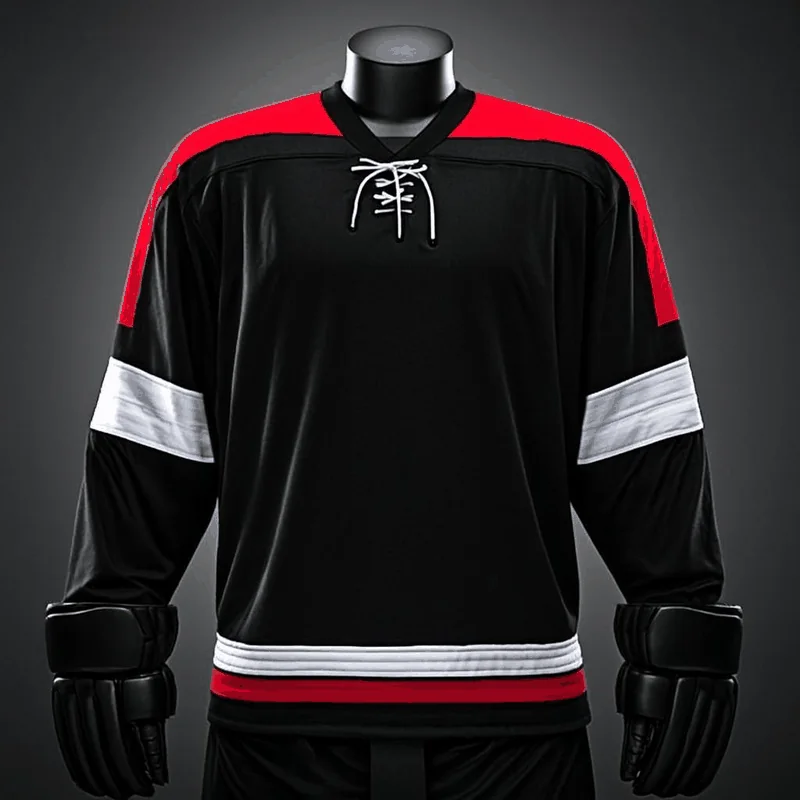
The hockey jersey is the most abused garment in team sports. It is pulled over armored shoulders, grabbed at speed in the corner, laundered weekly for eight months and still expected to look sharp in the championship photo. This guide covers everything that actually matters when ordering custom ice hockey jerseys in 2026 — pro-weight air-knit fabrics, fight straps, drop-tail construction, lettering choices, sizing over pads, roller hockey variants and real team pricing — written by the manufacturing team in Sialkot that produces sublimated hockey uniforms for clubs across North America, Europe and Australia.
01What makes a hockey jersey different?
A hockey jersey looks like a big, loose T-shirt — and that apparent simplicity is exactly why so many custom orders disappoint. Buyers assume any oversized jersey will work, then discover by December that collars have stretched, elbows have torn and hems ride out of the pants.
Four construction features separate a genuine hockey jersey from a generic one:
- Heavyweight construction — the fabric and seams must survive being grabbed, tugged and stretched along the boards without tearing or losing shape.
- A fight strap — an internal strap anchoring the jersey to the pants so it cannot be pulled over a player's head.
- A drop-tail hem — the back is cut longer than the front so the jersey stays tucked over the pant shell through a full game.
- Generous elbow and shoulder room — the jersey must move freely over shoulder pads, elbow pads and a chest protector without restricting a shot.
Nail those four and everything else is aesthetics. Miss them and no design will save the order. The finished sets in our ice hockey collection show what correct construction looks like on real teams.
02Fabric: air-knit and pro-weight polyester
Custom hockey jerseys use heavyweight air-knit polyester between 250 and 300+ GSM — roughly double the fabric weight of a soccer or basketball jersey. That weight exists for one reason: surviving a season of pulling.
- Air-knit texture — the open, slightly porous knit used on pro jerseys. It breathes far better than a closed interlock of the same weight and stretches in both directions, so it drapes cleanly over bulky pads.
- Pro weight (280–300+ GSM) — the classic heavyweight of contact hockey: dense, opaque and extremely resistant to grabbing and pilling.
- Mid weight (230–260 GSM) — increasingly popular for youth, rec and shinny leagues; cooler and cheaper, with most of the durability.
- Reinforced shoulders — look for double-needle or taped shoulder seams; that seam carries the full weight of the garment every time the jersey is pulled.
Air-knit polyester is also exactly the fabric that sublimation printing bonds with, so custom hockey jerseys take full-color decoration with no compromise to the knit — we explain the chemistry in Sublimation vs Screen Printing: Which Is Better for Custom Jerseys?
03The anatomy of a pro-cut jersey
A pro-cut jersey is a system of panels engineered around equipment. Knowing the anatomy helps you specify it correctly:
- Panel construction — front panel, back panel, sleeve sets and a shoulder yoke, cut so seams fall where equipment flexes rather than where it rubs.
- The drop tail — the back hem extends 5–8 cm below the front hem. Worn over the pant shell, it keeps the jersey tucked when a player skates, sits or falls. A straight hem signals a jersey designed for another sport.
- The fight strap — a strap of heavy fabric sewn inside the back hem that threads through the pants and fastens. In contact hockey it stops the jersey being pulled over the head during an altercation — also a player-safety rule in most leagues. If your league requires one, say so at ordering — straps must be sewn in during construction, not added later.
- The reinforced collar — a heavyweight collar with internal taping, coverstitched down. Cheap collars roll, fray and stretch out within a season of being pulled over pads.
Factory Tip — The Drop-Tail Check
- Have your tallest player sit on a bench wearing full gear. The drop tail must stay tucked over the pant shell when seated — this is exactly where short hems fail.
- Repeat with arms raised in a shooting motion: the front hem should not pull up past the pants and expose the belly pad.
- If either check fails, order the hem extended by at least 5 cm. On custom jerseys the pattern is yours — length costs almost nothing at the patterning stage and cannot be fixed after cutting.
04Designing your team identity
Hockey has the strongest visual heritage of any team sport, and the best custom designs borrow its grammar deliberately:
- Vertical stripes — the most classic device in hockey, straight from the Original Six era. Two or three broad stripes from yoke to hem still read instantly as hockey.
- Chest logo dominance — hockey is a crest sport. A single centered crest of roughly 20–25 cm carries the identity; resist adding competing chest elements.
- Shoulder yoke colors — a contrast yoke frames the crest and pairs with any stripe layout. It is the highest-impact, lowest-risk design move in the sport.
- Hem and sleeve stripes — matched stripes at hem and cuffs tie the jersey to the socks and create the coordinated look of pro kits.
- Modern sublimated layouts — gradients, tonal camo and faded stripes only exist because of sublimation; a growing share of club designs now blend one heritage element with one modern one.

05Numbers, names and lettering
Numbers do double duty on a hockey jersey: identity for the crowd, readability for officials and game film.
- Back numbers — 25–30 cm (10–12 in) is the pro standard, in a single layer with a contrasting outline so they read from the far end of the rink.
- Sleeve numbers — 10 cm (4 in) on each sleeve for identification in scrambles and on video.
- Names — straight or arched across the back yoke in a block font with a clean outline. Keep name bars under 30 characters including spaces.
Choose between layered twill and sublimated numbers. Layered tackle twill — fabric numbers stacked and stitched down — gives the raised, premium feel of pro lettering and is the traditional choice, at higher per-piece cost. Sublimated numbers are dyed straight into the knit: unlimited colors, gradients included, lighter weight and cheaper at every quantity. Most clubs now run sublimated numbers front and sleeve, reserving twill for the back number.
06Full team packages
A hockey program is more than one jersey. Most clubs order the complete package in a single production run:
- Home and away game jerseys — a light set and a dark set of the same design, or two color-inverted variants of it.
- Matching socks — hockey socks knit to match the jersey's hem and cuff stripes; most clubs order a pair per set so home and away coordinate.
- Practice jerseys — lighter mid-weight jerseys with numbers only, sized generously so they fit over gear.
- Trainer and manager jackets — softshell or padded bench jackets carrying the same crest, so the whole program looks intentional from the stands.
Ordering everything together is not just convenient — it is cheaper. One production run, one quality standard, one shipment, one design archived for next season's reorders. See SPORTIFY team packages for how full hockey programs are structured and priced.
07Roller hockey and ball hockey variants
Custom roller hockey jerseys and ball hockey jerseys follow the same design language but not the same construction spec. With no ice and no fighting in most leagues, both the equipment and the abuse profile change:
- Lighter fabric — 200–250 GSM air-knit or semi-mesh, because players overheat faster on sport court than on ice.
- No fight strap — most roller and ball hockey leagues do not require one, and omitting it saves cost and weight.
- Straight or shortened hem — roller pants are cut differently, so the long drop tail is unnecessary.
Clubs that field both ice and roller squads usually keep a single identity — same crest, same colors, with the roller version built lighter. Tell your manufacturer which variant you need before patterns are cut; the differences live in the pattern, not the artwork.
08What custom hockey jerseys cost in 2026
Expect $30–$60 for a sublimated pro-weight game jersey, $20–$35 for a replica or fan version, and $80–$150 per player for a full home-and-away package with socks. Within those ranges, price moves with fabric weight, twill versus sublimated lettering, and quantity.
| Item | Budget | Premium |
|---|---|---|
| Game jersey (sublimated, pro-weight) | $30–$45 | $45–$60 |
| Replica / fan jersey | $20–$28 | $28–$35 |
| Game socks (per pair) | $8–$10 | $10–$14 |
| Practice jersey | $15–$20 | $20–$30 |
| Full package (2 jerseys + socks) | $80–$110 | $110–$150 |
For the full quantity-by-quantity economics — and how hockey compares with football, soccer and basketball — see How Much Do Custom Team Uniforms Cost? The 2026 Price Guide.
Design your team's hockey identity
Send your crest, colors and roster size — SPORTIFY's design team returns a free digital mockup and a firm quote before anything is cut.
09Sizing over pads
A hockey jersey is sized to be worn over equipment, so the golden rule is: measure over pads, never over a T-shirt.
- Measure chest over shoulder pads and chest protector with a soft tape, arms relaxed. That number — not street-clothing size — is what you match to the manufacturer's chart.
- Expect to size up — most players wear a hockey jersey one to two sizes above their shirt size. Where a chart lists "fits over gear" chest ranges, use those columns.
- Check sleeve length in a shooting pose — cuffs should reach mid-forearm with arms extended, without covering the gloves.
- Goalies need a goalie cut — wider arms and body for the blocker and catcher. Order the goalie's jersey in a dedicated goalie pattern, not simply a bigger size.
- Add two spares in the most common sizes. Late signings and torn jerseys otherwise mean rush fees and color-batch risk on reorders.