
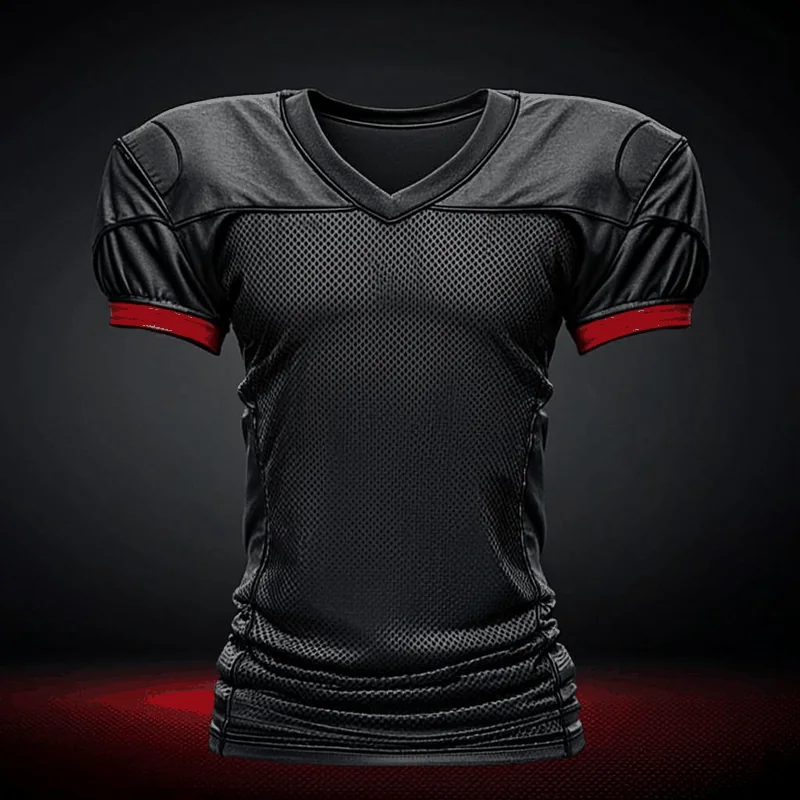
A football uniform is the most protective, most customized and most scrutinized garment in team sports. This guide covers everything that actually matters when ordering custom football uniforms in 2026 — jersey construction, integrated pads, fabric weights, decoration methods, roster sizing and real-world pricing — written by the manufacturing team that produces sublimated football uniforms for teams in the USA, Europe and Australia.
01What makes up a complete custom football uniform?
A full football uniform is a system of interlocking pieces, not a single jersey. Understanding each component helps you order the right quantities and avoid last-minute scrambles mid-season:
- Game jersey — the visible identity layer. Youth and amateur teams typically choose integrated-pad-ready jerseys; pro and semi-pro teams often wear shell jerseys over separate padding.
- Game pants — integrated pants with built-in knee, thigh, hip and tail pads have been the standard at youth and high-school level since integrated protection simplified certification.
- Practice jersey — a lighter, lower-cost jersey for daily practice, usually a simple mesh or semi-mesh body with numbers only.
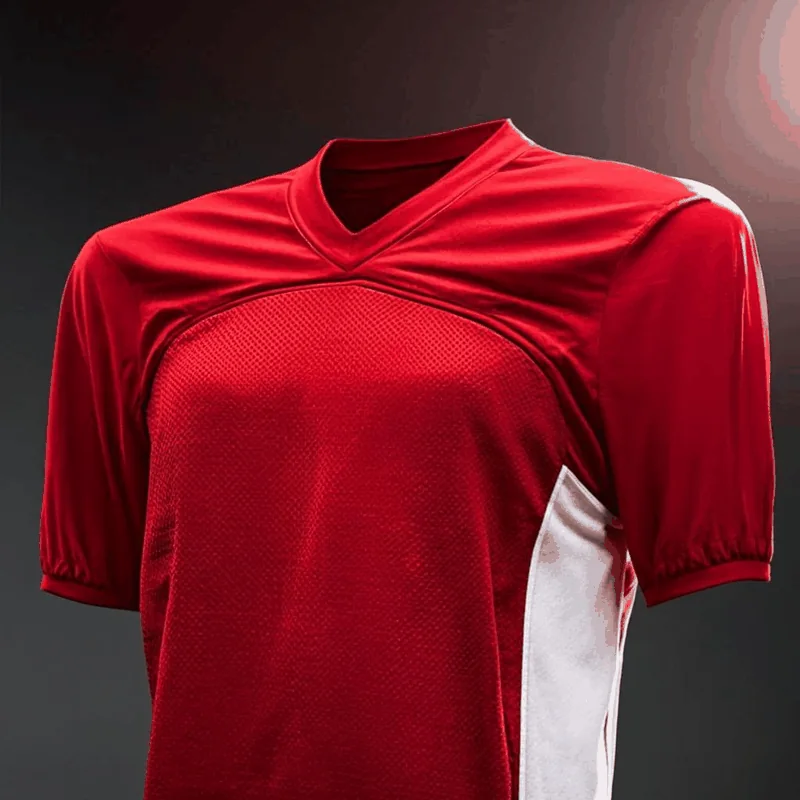
- Side panels and inserts — contrast color side panels stretch the visual design and improve fit through the shoulders.
- Numbers — home and away teams need compliant numbering; most leagues require front, back and sometimes shoulder numbers.
- Optional layers — warm-up hoodies, coach polos, sideline jackets and team backpacks complete the program (see team packages).
02Integrated-pad jerseys vs shell jerseys: which should your team buy?
Integrated-pad uniforms have padding sewn directly into the garment, while shell uniforms are worn over separate pad sets or girdles. That single difference drives most of your buying decision:
| Factor | Integrated-Pad Uniform | Shell Jersey + Separate Pads |
|---|---|---|
| Typical level | Youth, high school, amateur, flag | College, semi-pro, professional |
| Convenience | Pull on and play — one garment | More pieces to manage and size |
| Cost per player | Lower overall (no separate pad set) | Higher (pads purchased separately) |
| Protection customization | Fixed pad placement | Players choose pad thickness and fit |
| Washing | Pads stay in — check manufacturer wash instructions | Pads removed before washing |
For most school and club programs, integrated uniforms win on simplicity and total cost. Programs with athletic trainers and equipment managers often still prefer shells for the flexibility.
03Which fabric should a custom football jersey use?
The best custom football jerseys use polyester interlock or polyester mesh between 150 and 230 GSM. Fabric weight (GSM — grams per square meter) is the number most buyers ignore and most regret ignoring:
- 150–170 GSM interlock — the modern standard for practices and skill positions. Light, breathable, dries fast.
- 180–230 GSM heavy interlock — the classic "pro weight" for linemen and physical play. More durable, slightly warmer.
- Mesh and semi-mesh panels — underarm and back panels that dump heat during August two-a-days.
- 4-way stretch poly-spandex blends — increasingly common in fitted cuts; check that the blend is sublimation-ready if you want printed designs (90%+ polyester content is the safe zone).
- Recycled polyester (RPET) — performance-grade polyester made from recycled PET bottles; the sustainability choice more clubs are asking for in 2026, at essentially identical performance.
Factory Tip — The Stretch Test
- Pull the fabric diagonally. A quality football jersey recovers instantly; a cheap one keeps a "baggy" stretched look after one season.
- Check the collar: double-needle coverstitch on a reinforced placket survives rosters of 30+ players. Single-needle collars roll and fray.
- Ask for the exact GSM in writing. "Pro weight" is marketing; 220 GSM is a specification.
04Sublimation vs tackle twill vs screen printing for football jerseys?
Full sublimation is the best decoration method for 95% of custom football teams; tackle twill is the premium stitched option for traditional looks; screen printing only makes sense for single-color, tight-budget practice gear. This is the decision that determines how your uniform looks after 20 washes:
| Method | Colors | Durability | Cost | Best for |
|---|---|---|---|---|
| Full sublimation | Unlimited, photographic | Cannot peel or crack — dye is inside the fiber | Flat, regardless of colors | Game jerseys, gradients, camo, sponsor logos |
| Tackle twill | Layered fabric letters/numbers | Very high (stitched) | Highest — per-piece stitching | Traditional pro-style lettering, college looks |
| Screen printing | Limited per color | Cracks and peels over time | Cheapest at volume | Practice jerseys, 1–2 color designs |
Because sublimation dyes the polyester itself, a sublimated camo, gradient or photographic design costs the same as a two-color design — which is why it dominates custom football. We compare the two main methods in depth in Sublimation vs Screen Printing: Which Is Better for Custom Jerseys?
05How do you design a football uniform that looks professional?
Great football designs share a few rules regardless of style. When our design studio lays out a custom football uniform, we work through this sequence:
- Lock two primary team colors and one accent. Three colors is the ceiling before a design turns noisy; use the accent for numbers, trim and one design element only.
- Choose a number style first. Numbers are readable from 30 meters or the design fails. Full-width, high-contrast numbers with an outline read best on camera and from the stands.
- Use side panels for movement color. A contrast side panel is the single most-used design device in modern football — it visually lengthens players and frames the jersey.
- Keep sponsor logos to 2–3 placements. Chest, sleeve and back-neck positions in consistent sizes. Sublimation means logos cost nothing extra — restraint is the discipline.
- Design home and away together. A color-inverted variant of the same design looks intentional; two unrelated designs look like two different clubs.
Looking for inspiration? The SPORTIFY football uniforms collection shows sublimated sets across camo, split-color, pinstripe and stealth designs, and our gallery includes finished team programs.
06How do you size a full football roster?
Sizing is where uniform orders fail — order by measured roster, not by guesswork, and always add 2–3 spare jerseys. A workable process:
- Collect chest and waist measurements for every player (a soft tape and 10 minutes per squad). Sizes like "Youth L" vary between manufacturers; body measurements do not.
- Map measurements to the manufacturer's published size chart, not to retail brand sizes your players already own.
- Order 2–3 spare jerseys and pants in common sizes (M, L, XL). Players join late, jerseys tear, and mid-season reorders cost rush fees.
- Ask about extended sizing before you commit. A manufacturer that caps at 2XL leaves your line trapped in borrowed gear.
- Number each jersey at ordering so name and number printing lands on the correct size — swapping printed numbers later is impossible.
07How much do custom football uniforms cost in 2026?
Expect $35–$75 per player for a full custom sublimated game set (jersey + integrated pants), $15–$25 for a practice jersey, and $60–$110 for a complete team package including warm-ups. Within those ranges, price moves with:
- Quantity — full-roster orders unlock volume pricing; single replacement pieces cost more per unit (though no-minimum ordering exists for exactly that situation).
- Fabric weight — 220+ GSM heavy interlock carries a premium over 160 GSM.
- Decoration — sublimation is flat-cost; tackle twill lettering adds per-piece cost.
- Extras — integrated pads, names on jerseys, and custom pant designs.
We break pricing down across every sport with real numbers in How Much Do Custom Team Uniforms Cost? The 2026 Price Guide.
Get a free mockup for your team
Send your logo, colors and roster count — SPORTIFY's design team returns a digital mockup and a quote, free, before anything goes to production.
08What should you ask a custom football uniform manufacturer before ordering?
Whether you order from SPORTIFY or anyone else, these seven questions separate professional manufacturers from resellers:
- "What GSM fabric will you use?" — a real manufacturer answers instantly with a number.
- "Who sews the garments — your factory or a third party?" — factory-direct means one quality standard and one accountable partner.
- "Is a mockup included before production?" — it should be free and unlimited-revision within reason.
- "What is the production time after mockup approval?" — get it in writing, including the shipping estimate to your country.
- "Can I see photos of recent teams you've produced?" — a working factory ships continuously and can show it.
- "What happens if a jersey is defective or a size is wrong?" — the answer reveals how the relationship will go when something goes wrong.
- "Do you handle reorders of the same design next season?" — your design files should be archived so season two is a reorder, not a redesign.
09How far ahead of the season should you order?
Order 6–8 weeks before your first game. That budget covers 3–5 days of design and mockup rounds, 2–3 weeks of production, and 5–10 days of international shipping, with a week of buffer for customs and roster changes. Rush production exists — but planning to need it is planning to pay for it.
10What are the 2026 custom football uniform design trends?
From the hundreds of team designs crossing our cutting tables this year, five directions dominate 2026:
- Stealth monochrome — all-black or all-charcoal sets with tone-on-tone graphics and a single accent color.
- Digital and micro camo — pixelated camo fades that read as texture from distance, only possible with sublimation.
- Retro cream-and-brown — vintage palettes borrowed from 1970s pro football, modernized with fitted cuts.
- Hydraulic gradients — smooth color transitions from shoulder to hem, especially teal-to-navy and red-to-black.
- Sustainability — clubs specifying RPET recycled polyester and asking where fabric is sourced; the fastest-growing request of 2026.