
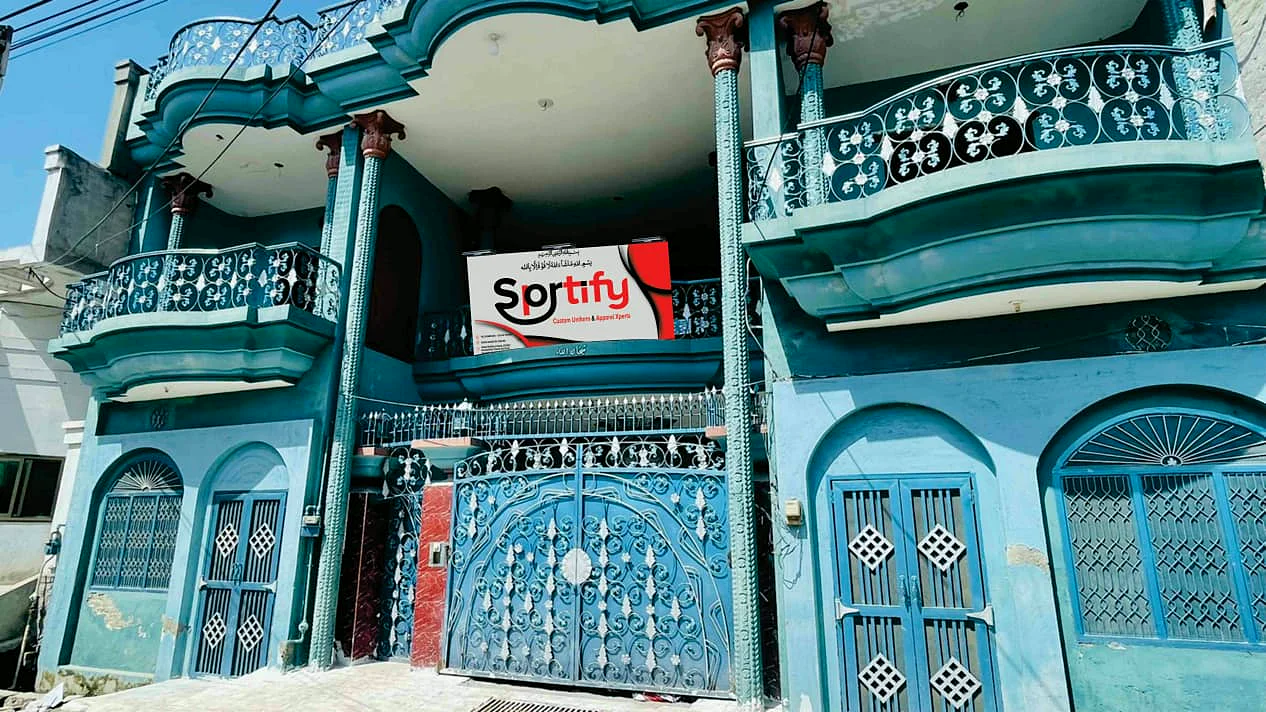
Match balls, cricket bats, goalkeeper gloves, field hockey sticks — and increasingly the custom sublimated uniform your team is designing — a remarkable share of the world's sporting goods begins in one city: Sialkot, Pakistan. This guide explains why, and what buying factory-direct from Sialkot means for teams in the USA, Europe and Australia. It is written from inside the factory.
01The quick answer
Sialkot is a city of roughly one million people in Punjab, northeast Pakistan, exporting several billion dollars of goods a year, including an extraordinary share of the world's sports equipment. A majority of the world's hand-stitched match balls are sewn here, and World Cup match balls have been made in its factories for decades. It is also a leading source of cricket bats, hockey sticks, gloves, protective gear and — in its newest chapter — custom sublimated sportswear.
Three forces explain the concentration: a century of craft skill passed through generations of manufacturing families; a cluster where every input sits within kilometers of every factory; and export infrastructure the industry built for itself. Replicating that takes decades — which is why global brands keep sourcing here instead of chasing the next low-cost location.
02A century of craft
The industry began in the 1880s, when the sporting demands of a British colonial garrison met a city already skilled in leatherwork and toolmaking. Local craftsmen began repairing imported equipment, then building it: cricket bats, hockey sticks, polo gear and balls. By the 1930s Sialkot was a recognized name in British catalogs, with skills passed from master to apprentice inside family workshops that grew into export houses.
After independence the trade went global, and the hand-stitched soccer ball became the city's signature: by the 1990s Sialkot produced most of the world's hand-stitched match balls, including World Cup match balls.
Two decisions define the city's character. When port delays in Karachi threatened export deadlines in the 1980s, Sialkot's exporters built their own dry port rather than wait for the state. When air freight stayed the bottleneck, they built Sialkot International Airport themselves — opened in 2007, still run by the local business community. This is a city that solves its own logistics.
03The cluster effect
Economists call it clustering: when an entire supply chain concentrates in one place, quality and speed compound instead of eroding at every handoff. Sialkot is one of the densest clusters on earth — within a few kilometers: tanneries, fabric knitters, dye houses, sublimation printers, embroidery units, cutting studios, packaging makers and forwarders shipping daily.
For a custom uniform, the cluster effect shows up in the calendar and the stitching:
- Same-day iteration. A designer walks a sample across town and inspects printed fabric the same afternoon.
- Specialized labor. Operators who have closed ten thousand collars sew yours better than generalists ever will.
- Machine depth. When a press needs service, the specialist technician is minutes away.
- Faster problem-solving. A shade problem is fixed at the dye house tomorrow, not negotiated for a month.
A dispersed chain — fabric from one country, printing in a second, sewing in a third — adds days, cost and quality risk at every hop. The cluster removes the hops.
04From balls to apparel
Sportswear was a natural extension of what Sialkot already did brilliantly. Gloves and protective equipment had trained generations of cutters and operators on performance materials, tolerances and reinforcement — the exact skills a custom uniform demands. The city re-aimed existing precision rather than learning apparel from scratch.
The catalyst was technology. As sublimation matured in the 2000s, polyester knit plus digital printing meant unlimited custom design at any quantity — one jersey or one hundred, same setup. Sialkot's cutting and sewing depth met the new method, and a custom sportswear industry grew around it. Today its factories produce fully sublimated uniforms for every sport: football, soccer, basketball, baseball and softball, volleyball, cheerleading and ice hockey.
Why that method beats screen printing for custom teams is explained in Sublimation vs Screen Printing: Which Is Better for Custom Jerseys?
05What "factory-direct" really means for your team
The traditional path is long: a brand designs a kit, a factory produces it, an importer distributes it, a retailer sells it — every layer takes margin and adds weeks. Factory-direct removes the middle of that sentence. Your team talks to the design studio; the design goes to the cutting table next door; the uniforms ship to your door. When you message the factory, you message the people who cut your fabric.
| Factor | Factory-Direct (SPORTIFY) | Traditional Brand–Retail Chain |
|---|---|---|
| Who you deal with | The factory's own design and production team | Store staff or a brand sales rep |
| Layers before you | None — factory ships direct | Brand → importer → retailer |
| Customization | Full custom: design, fabric, fit, names, numbers | Catalog designs with limited options |
| Typical custom jersey price | $16–$30 per unit at roster quantities | $45–$90+ per retail equivalent |
| Typical timeline | 2–3 weeks production + 5–10 days shipping | Seasonal buying cycles in months |
| Accountability | One factory owns the outcome end-to-end | Distributed across every layer |
Read SPORTIFY's own story on the about page.
06Inside a modern Sialkot sportswear factory
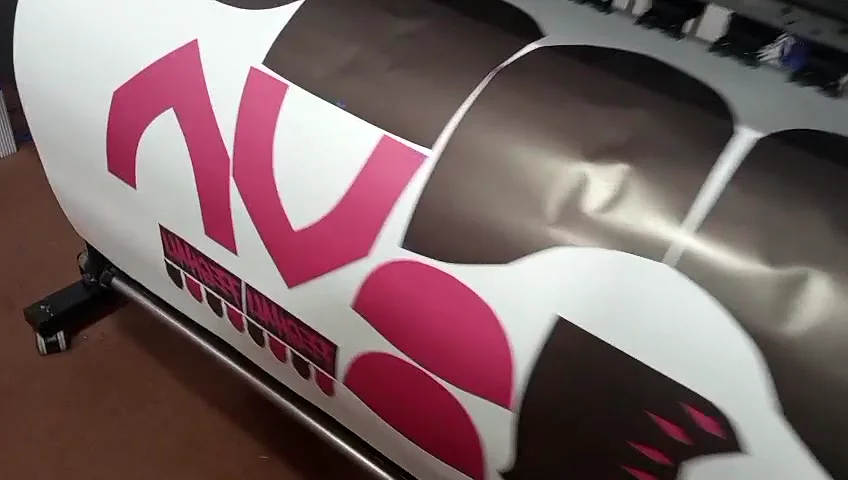
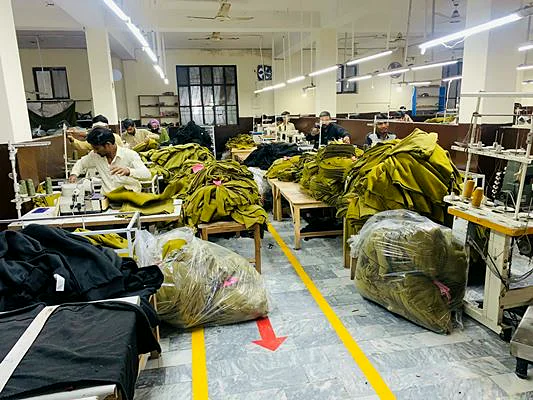
This is SPORTIFY's own process, representative of a modern Sialkot factory — every stage under one roof:
- Design studio. Your brief becomes a digital mockup — layout, colors, names, numbers — approved before anything is made.
- Fabric storage and inspection. Rolls are checked for weight (GSM), shade and defects before cutting — a substandard roll never becomes a jersey.
- Printing. Designs print onto transfer paper, and the press fuses the dye permanently into the fabric.
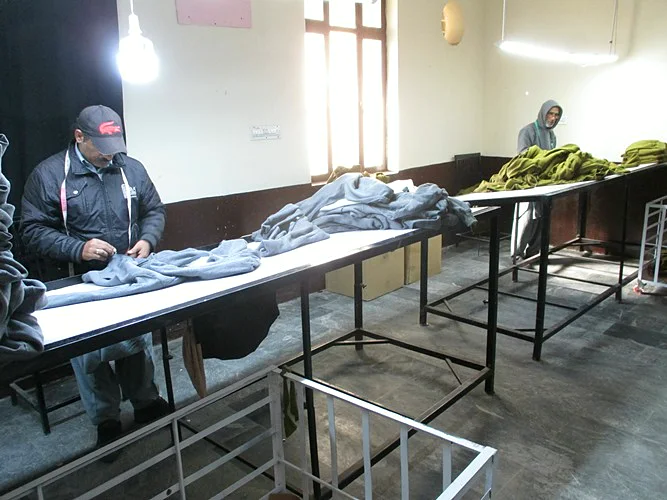
- Cutting. Printed panels are cut to pattern — single pieces or nested stacks.
- Sewing lines. Specialized operators close collars, set sleeves and hem to a measured specification.
- In-line quality control. Measurements and stitching are checked during production, not only at the end.
- Finishing and packing. Final inspection, tagging and export-grade packing for courier or air freight.
07Quality systems that export to the world
You do not ship into the USA, Europe and Australia for decades on promises. Export quality is a system of inspections that assumes problems and catches them early:
- Incoming inspection — every fabric roll is checked for GSM, shade and weaving defects before production.
- In-line inspection — garments are measured and stitching checked during sewing, while corrections are cheap.
- Final AQL-style sampling — orders are sampled statistically before release, the acceptance framework used across export manufacturing.
- Export documentation — commercial invoices and packing lists prepared correctly so shipments clear customs without drama.
08Ethical and sustainable manufacturing
Sialkot's ethical story deserves honesty rather than marketing gloss. In the 1990s, child labor in the city's soccer ball industry became international news — and the response rebuilt the industry. The Atlanta Agreement brought the ILO, global brands and local manufacturers together; stitching centers were registered and independently monitored; children moved into funded schools. Today Sialkot's exporters operate under labor scrutiny most clusters have never faced — and its better factories treat that history as the reason they stay serious.
At SPORTIFY we state what we do and no more: an adult workforce, fair wages paid on time, safe conditions — we would rather show you the factory than invent certificates. Ask any manufacturer what they can document, not what they claim.
On materials, the practical sustainability choices are concrete: RPET recycled polyester — performance-grade fabric from recycled PET bottles at identical performance and price — plus fabrics sourced to OEKO-TEX-style safety standards with spec sheets on request, and sublimation itself: a dry process with no screen-washing wastewater, printing only the fabric that will be cut.
09Shipping from Sialkot to the USA, Europe and Australia
Sialkot's self-built airport exists to move exports fast. In practice:
- Express courier (DHL, FedEx, UPS) — the standard for samples, single jerseys and small batches: typically 5–10 business days door to door to the USA, Europe and Australia, fully tracked.
- Consolidated air freight — for full team orders: a few days longer than courier, plus customs clearance.
- Customs basics for team buyers — shipments arrive with a commercial invoice and declared value; depending on your country you may owe import duty, VAT or GST above the local threshold. Budget for it and insist your manufacturer declares accurately.
Plan 6–8 weeks total from mockup approval to first game. For how shipping, fabric and fit add up in dollars, see the custom uniforms cost guide.
10How to vet any overseas manufacturer
Whether you buy from SPORTIFY or anyone else, these eight checks separate real manufacturers from resellers with a nice website:
- Communication speed. Same-business-day replies during working hours. A factory that wants your order answers fast.
- Sample quality. Order one piece before any roster order — no-minimum ordering makes this cheap and easy.
- Unedited photos of yesterday's production. Real factories send them the same day.
- References from teams in your country.
- A verifiable address and company registration.
- Specifications in writing — fabric GSM, stitching, sizing — not "premium quality."
- A design process with mockups before any deposit is paid.
- Sane payment terms — a deposit and a balance, never 100% upfront.
Factory Tip — The Photo Test
- Ask any manufacturer for unedited photos of yesterday's production run — their own cutting tables, presses and sewing lines, not catalog images.
- A working factory can send them the same day.
- Excuses, stock photos or silence are your answer.
- Ask again mid-production for your order's photos — factories that do it once will do it always.
Work directly with the factory
SPORTIFY designs, prints, cuts, sews and quality-checks every uniform under one roof in Sialkot — and answers your messages the same working day.